 Sarasota Siding
 Why Lakewood Ranch Siding Repair Isn't a One-Size-Fits-All Job
Lakewood Ranch is one of the more visible planned communities in the greater Sarasota area, and that comes with its own set of expectations for exterior work. Homes here tend to be newer than the coastal bungalows and older subdivisions closer to downtown Sarasota, which means the siding itself is often a specific fiber cement profile — lap, shake, or board-and-batten — installed to match a builder spec or an HOA-approved palette. A repair that doesn't match that profile, reveal, or color sticks out immediately, and in a community with active architectural review, that mismatch can turn into a compliance headache on top of a cosmetic one.
That's the core difference between generic siding repair and siding repair done right for a Lakewood Ranch home: it's not just patching a hole or replacing a cracked board. It's matching an existing system precisely enough that the repair disappears, while also addressing whatever caused the damage in the first place so it doesn't come back next storm season.
What Sarasota-Area Weather Does to Siding Over Time
Lakewood Ranch sits inland of the Gulf, but it isn't shielded from what the Sarasota region deals with every year. Hurricane-force winds during tropical systems put direct pressure and impact loads on exterior cladding, and wind-driven rain gets forced sideways into joints, seams, and fastener points that were never designed to handle water moving horizontally. Add in Florida's intense, near-constant UV exposure, which breaks down caulking and finishes faster than in most of the country, and salt air that travels well inland on Gulf breezes, and you have a climate that's genuinely tough on building exteriors — even for homes that never see storm surge or direct coastal spray.
Individually, none of these are unusual for Southwest Florida. Together, over years, they're why siding that looked fine at installation starts showing joint separation, caulk failure, and finish fading well before a homeowner expects to think about it again.
The Compounding Effect
The real damage rarely comes from one bad storm. It comes from small deficiencies — a gap at a butt joint, a fastener that backed out slightly, caulking that dried out and cracked — that let moisture in gradually. UV and heat cycle the material and finish season after season, and by the time damage is visible from the ground, there's often more happening behind the siding than in front of it.
Signs Your Lakewood Ranch Home Needs Siding Repair
Most homeowners don't inspect siding closely until something looks obviously wrong, but the earlier these signs get caught, the smaller and cheaper the repair.
- Visible cracking, chipping, or splitting along boards, especially near corners and joints
- Soft or spongy spots when pressed, which usually means moisture has gotten behind the siding
- Caulk that's cracked, shrunk, or pulled away from joints and trim
- Streaking, staining, or discoloration that doesn't wash off
- Boards that appear to be bowing, buckling, or separating slightly from the wall
- Paint or finish that's peeling, chalking heavily, or fading unevenly compared to nearby sections
- Any soft spots, staining, or mold on interior walls that back up to exterior siding
- Fasteners visibly popped, rusted, or backed out of the surface
Any one of these on its own might be minor. Several together, or any sign paired with interior staining, usually means it's time for an actual inspection rather than a guess.
What a Correct Siding Repair Actually Involves
A repair that just covers the visible symptom without addressing the cause is a repair that fails again — often within a year or two in this climate. Doing it correctly means treating every repair as a small diagnostic project, not just a patch.
Matching Material, Profile, and Finish
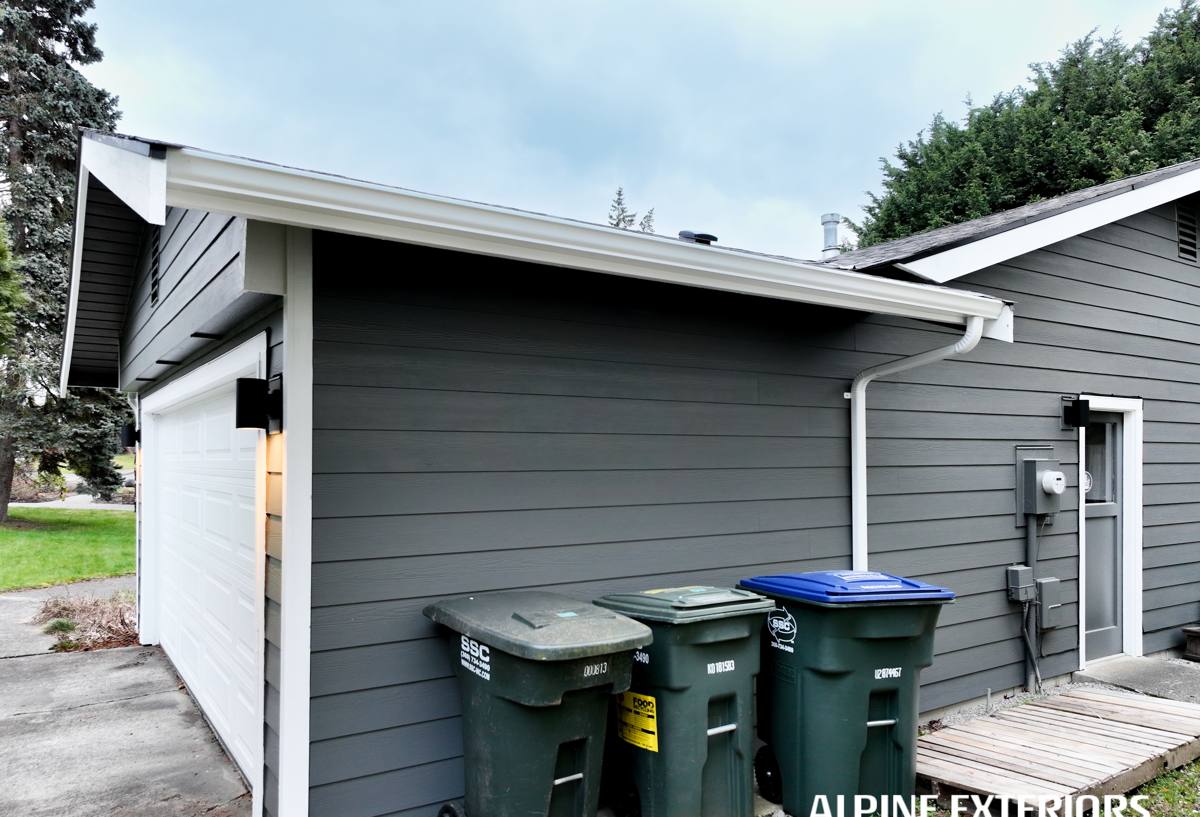
Fiber cement siding comes in specific plank widths, exposure reveals, and textures. A repair board cut from the wrong profile, or fastened with a different reveal than the surrounding wall, will read as a visible seam even after painting. When we repair a section, we match the existing product line and profile so the finished wall reads as one continuous surface, not a patchwork.
Checking What's Behind the Siding
Visible damage is often the smallest part of the problem. Before closing up a repair, we check the water-resistive barrier, flashing, and sheathing behind the damaged section for moisture intrusion or rot. Siding that looks like a simple crack repair sometimes reveals a flashing detail that failed months earlier — and patching over that without fixing it just buries the problem for the next storm season.
Fastening and Sealing to Spec
Fiber cement has specific fastener spacing, type, and placement requirements, and sealant needs to be a product rated for exterior fiber cement joints — not general-purpose caulk that will fail under Florida sun within a season or two. Skipping these details is a common shortcut in rushed repairs, and it's usually why the same spot needs fixing again within a year.
Repair or Replace? How We Make That Call
Not every issue needs a full section replaced, and not every crack can be safely left as a spot repair. We look at the extent of damage, how much moisture has already gotten behind the wall, and how old the existing siding is before recommending a direction.
| Situation | Typical Recommendation | Why |
|---|---|---|
| Isolated crack or impact damage, no moisture behind it | Targeted board replacement | Contains the fix to the affected area without disturbing sound siding |
| Failed caulk joints across multiple areas | Re-sealing with proper fiber cement sealant | Addresses the actual failure point before it lets water in |
| Soft spots with confirmed moisture intrusion | Remove, inspect sheathing, repair or replace as needed | Hidden rot has to be dealt with, not covered over |
| Widespread fading, chalking, or aging finish | Evaluate whole-elevation or full replacement | Patch repairs on badly aged siding rarely match, and don't solve the underlying age issue |
| Storm damage across a large area | Full section or elevation replacement | More efficient and structurally sound than piecing together many small repairs |
We'll always tell you honestly which category your situation falls into, including when a repair is genuinely the right call and a full replacement would be overkill.
Our Siding Repair Process
- Inspection: We look at the damaged area and the surrounding siding, checking for moisture, fastener condition, and joint integrity, not just the obvious problem spot.
- Diagnosis: We identify the actual cause — impact, water intrusion, aged sealant, installation error — so the repair fixes the source, not just the symptom.
- Clear recommendation: You get a straightforward explanation of what needs to happen, what it involves, and why, before any work starts.
- Repair execution: Matching material and profile, correct fastening, proper flashing and sealant, done to the same standard as new installation work.
- Cleanup and walkthrough: We leave the site clean and walk the repair with you so you know exactly what was done.
Why James Hardie Is the Only Material We Repair and Install With
We install and repair exclusively with James Hardie fiber cement siding. We don't work with vinyl, LP SmartSide, or other fiber cement alternatives, and that's a deliberate standard, not an oversight. Vinyl softens, warps, and becomes brittle under the kind of sustained heat and UV Sarasota gets, and it has real limits in high-wind events. Engineered wood products bring moisture-related risks that are hard to manage in a climate this humid. James Hardie's HZ product lines are engineered specifically for high-humidity, high-UV climates like Florida's, the material is non-combustible, and the factory-applied ColorPlus finish holds color and resists the fading that plagues field-painted siding under intense sun. It also carries a strong transferable warranty, which matters when a home changes hands.
Practically, this means every repair we do on Hardie siding uses the correct product line, matching profile, and Hardie-approved fastening and sealing methods — so the repair performs the same way the original installation was designed to.
Why a Crew That Already Works in Lakewood Ranch Matters
Repairing siding in a planned community like Lakewood Ranch isn't just a technical job — it's a familiarity job. Crews who regularly work in the area already know the common Hardie profiles and color palettes used across the community's neighborhoods, which shortens the time it takes to source a correct match. They're also used to working within HOA aesthetic guidelines, so a repair doesn't create a compliance issue on top of a maintenance one. And because Sarasota-area weather affects every home in the area roughly the same way, a crew with local repair experience has usually already seen the specific failure pattern on your wall dozens of times before — which means a faster, more accurate diagnosis instead of guesswork.
If you're noticing cracked boards, failing caulk, soft spots, or fading siding on your Lakewood Ranch home, we're happy to take a look and give you a straight answer on what it needs. Reach out for a free, no-pressure estimate — there's a form right below to get started.